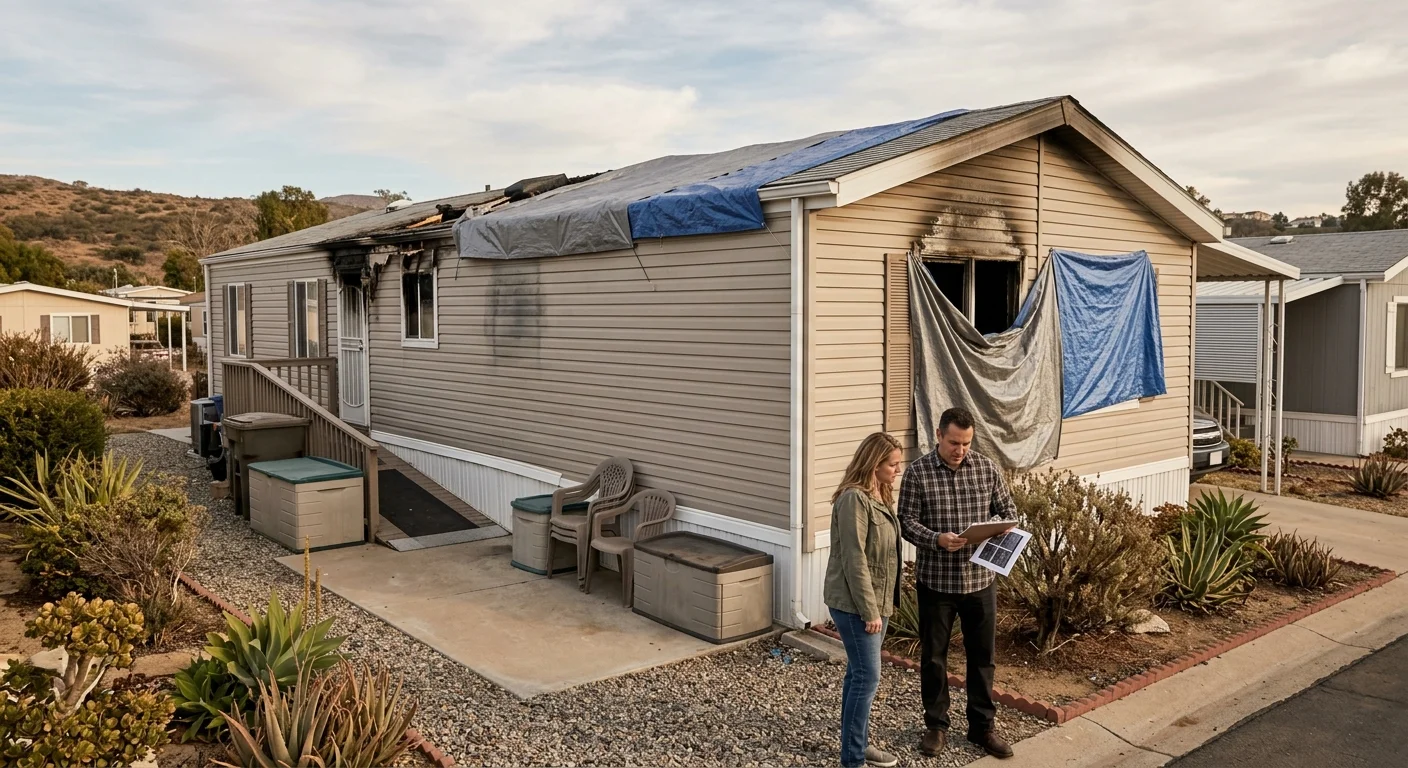
A San Diego County mobile home with major fire, smoke, or water damage is not a curb-side repair guess. Replacement is a sequence: written safety and insurance findings, a clear read on who controls the land, then removal, then a new unit the site can legally take. Land & Home SD does not inspect, insure, remove, sell, or install; we help owners line up those decisions and connect them with licensed local dealers.
Start with written safety and insurance findings
Stay out until the responding agency, or a qualified inspector they name, puts the condition in writing. A coach in an El Cajon or Chula Vista park can look standing from the street and still have heat, smoke, or suppression water in the chassis, floor, and walls. A home on private land in Ramona, Alpine, or unincorporated East County can have the same problem, plus well, septic, and driveway damage the fire fight left behind. Land & Home SD does not diagnose damage and does not call a unit safe or totaled. That finding belongs to inspectors, the fire or building agency, and your insurer.
Ask for the incident report from the agency that responded to your address. The City of San Diego, another incorporated city, and the unincorporated county are not the same shop. Insurers and later dealers will ask for that report. Keep copies of photos, HUD or HCD labels if they are still readable, and the current registration or title packet.
Open the claim under your actual policy. Do not treat a blog, an adjuster’s first visit, or a neighbor’s settlement as coverage. Manufactured home insurance in San Diego is a separate review because park coaches, private-land units, and HUD-code homes are not written like a tract house in Scripps Ranch. Living-expense help, contents, ordinance or law, and whether the policy will fund a replacement unit are policy questions. No rebuild average, no claim timeline, and no payout figure is verified for this page, so do not budget from a guessed cost to rebuild a house after a fire. If someone cites a statewide $10,000 home-improvement grant for this situation, that figure could not be confirmed from the sources this article is allowed to use. Check current County of San Diego housing programs and state pages yourself. Some county repair help is written for minor health and safety work, not as an emergency replacement fund, and the County sets eligibility, not a dealer.
Get the insurer’s position in writing before you sign a removal or purchase contract. Repair versus replace is still your decision after that paper is in. If the unit is older, walk the choice against repair, sell, or replace on an older mobile home, using the inspector’s scope, not a sales pitch.
Confirm who controls the park space or land
The damaged home and the dirt under it are often two different legal things. In a park in Oceanside, Escondido, Santee, or National City, you typically own the coach and rent the space. Park management and the park owner control whether a replacement may sit on that pad, what size it may be, and what utilities the space can take. California’s Mobilehome Residency Law exists as Civil Code Chapter 2.5 (sections 798 through 799.13) and applies to park residency, not to a manufactured home on private land. The specific tenant rebuild rights in that chapter could not be verified in full for this page. Get the park’s replacement rules in writing: space dimensions, setbacks, age or HUD-code rules, any dealer list, and whether the park will restore damaged infrastructure. Ask whether space rent continues while the pad is empty. If the park will not accept a new home, a factory order will not fix that.
On private land in Poway, Lakeside, or unincorporated East County, you control the lot, but you still do not control the permit path. Unincorporated lots go through San Diego County Planning and Development Services. Incorporated cities run their own building departments. County PDS 103 (revision 09/18/2025) covers eligible manufactured homes on private lots in County jurisdiction. That handout’s eligibility includes qualifying mobilehomes built September 15, 1971 through June 14, 1976, and manufactured homes built from June 15, 1976 with the stated approval. Roof-pitch and eave rules in that handout have exceptions and director-waiver language. Do not treat PDS 103 as a City of San Diego, Chula Vista, or El Cajon rule, and do not read the roof pitch as a snow-load rating.
California law splits the vocabulary. A mobilehome, under Health and Safety Code 18008, is a unit constructed before June 15, 1976. A manufactured home, under Health and Safety Code 18007, is constructed on or after that date and is built to the federal HUD Code. Factory-built housing, the modular path under Health and Safety Code 19971, is a different product and is not a mobilehome. After a fire, those labels change which agency, which installer, and which lender you are talking to.
Write down who signs: you, a co-owner, a lienholder, a park, a land lessor. HCD, not the DMV, handles manufactured-home registration and title when the home is still in that system. If the home was installed on a foundation system, HCD’s registration and titling guidance states it is no longer registered by HCD. That fact does not by itself prove lender approval or the record status of your particular home.
Separate damaged-home removal from replacement
Do not bundle “get this wreck out” and “set a new home” into one handshake. Removal is its own job: disconnect utilities, lift and haul the damaged sections, and dispose of or salvage what the insurer and the title will allow. Replacement is a dealer and installer job on a cleared, approved site. Mix the scopes and you get a fight over who owns debris, who holds the old title, and who pays when the pad is not ready.
The old home still has paperwork. For used manufactured homes, Health and Safety Code 18035 puts registration cards, title, and junior-lien copies into escrow on a resale, and the escrow officer may request a tax clearance from the county tax collector when the home is subject to local property tax. A fire loss is not the same as a resale, but liens, taxes, and HCD records do not vanish because the coach is gone. Confirm with HCD and, if a lender is on the title, with that lender, before a removal contractor cuts it up.
Use a written removal scope: what leaves the space, what stays (piers, skirting, sheds, carports), who calls SDG&E or the park for disconnects, and where the unit goes. The buying and placement process is the map for the new home. Removal has to finish, or at least sit under contract with dates the dealer can plan around, before a factory slot is real.
Park pads in the South Bay and central El Cajon are a different haul than a private lot up a narrow East County drive off State Route 67. Transport access, tree limbs, and turning radius belong in the removal quote and in the later delivery plan. Coastal north county parks in Oceanside or Carlsbad often run tighter pads and older utility laterals. Inland lots around Ramona and Alpine more often mix septic, wells, and long driveways. Land & Home SD owns no trucks and performs no haul-off. The matched removal contractor and the matched dealer do that work.
Match dealer and installer scopes to the site
California HCD licenses manufactured-home dealers and salespeople. Confirm the person taking your replacement order on HCD’s occupational licensing pages. Health and Safety Code 18024 lets the department cite a person acting as a dealer without a license, with penalties up to $2,000. Land & Home SD is a referral service. We are not a dealer, we hold no inventory, and we do not pull permits.
Ask for two written scopes. The dealer scope is the home: floor plan, HUD labels for a manufactured home built on or after June 15, 1976, delivery to the site, and what is excluded (awnings, decks, steps, AC, skirting). The installer scope is the site: set, utility connections, and, if you are going to a permanent foundation, the foundation package. Under Health and Safety Code 18551, installation as a permanent fixture requires a building permit, proof of ownership or a long-term lease of 35 years or more (or mutually agreed terms), evidence the home is lien-free or written lienholder consent, department-approved foundation plans, the manufacturer’s installation instructions, and an $11 fee per transportable section as stated in the statute (that fee may have been adjusted). Within five business days of a certificate of occupancy, the enforcement agency records a document naming the owner of the real property. Local agencies generally cannot require a permanent foundation for homes already on private property or in parks, with limited exceptions for park conversions.
Match the product to the dirt. A double-wide that fit an Oceanside park space in 1985 may not fit today’s setbacks. A private lot in Fallbrook or Valley Center may need well and septic capacity the old coach barely used. HUD Code governs the manufactured home structure and broadly preempts local construction rules for that structure. The state still regulates stabilizing systems, support systems, and foundations, consistent with the manufacturer’s design. Modular factory-built housing is inspected to California Building Standards Code, not the HUD Code. Do not order one product on paperwork written for the other.
Mobile home replacement is the service path for same-space or same-lot work. Site photos, a tape of the pad or setbacks, and the park or county letter belong in the first dealer conversation, not after the factory has started the floors.
Confirm approvals before ordering a replacement
A factory will take a deposit. An agency will not care. Get the park’s written acceptance, or the local building department’s path, before you lock a serial number. For the home itself, California HCD’s manufactured and mobilehome pages are the regulator’s front door. For the land, use County PDS in unincorporated areas and the city department if you are inside San Diego, Chula Vista, Encinitas, or another incorporated city. Details of each city’s mobile-home information bulletin are not verified in this article’s claims ledger, so read the current bulletin from the city, not from memory.
If you will finance, ask the lender which paper they need for a replacement after a loss: HCD title versus real property, park lease versus land you own, and whether they will lend on a unit going onto a leased space. HUD Title I can finance a manufactured home, a lot, or both. HUD states the home may be classified as personal property or as real estate, and that borrowers may lease the lot, including a site in a manufactured-home community or mobile-home park, with a required initial lease term of three years and at least 180 days’ advance written notice if the lease will be terminated. That is not an approval, a rate, or a term you have been promised. Your insurer’s payout and your lender’s conditions are separate files. Do not assume the claim check equals the dealer invoice.
You can often replace an old mobile home with a new manufactured home if the land controller and the permit agency accept that product on that site. Pre-1976 mobilehomes are not HUD Code homes. The replacement, if it is a manufactured home, will be a June 15, 1976-or-later HUD Code unit. How long that takes after a fire is not a figure this page can publish. There is no verified countywide rebuild clock.
Hold the order until four papers exist: safety or inspection writing, insurance position in writing, land or park control in writing, and a dealer-installer scope that names this address. Then the replacement is a project, not a hope.
When to call us
Call before you sign a combined removal-and-replacement contract, or send a factory deposit on a home the park or city has not accepted. That conversation is worth it when the inspector’s writing, the insurer’s letter, and the land controller’s rules still do not line up. The consult is free to buyers and does not obligate you. Call us at (858) 400-4608 and we’ll walk through your options and connect you with a licensed local dealer.